
Quantum materials behave in unexpected ways compared to the classical materials we are used to. These materials – such as magnets, superconductors and topological insulators – can exhibit unusual properties, like conducting electricity with little or no energy loss, and display quantum phenomena such as superposition and entanglement.
Much like baking a cake, the careful addition, mixing and synthesis of atomic components in material systems can create unique and exotic properties. These properties are critical for advanced quantum information technologies such as ultra-efficient devices for electronics, quantum computing, quantum sensing and quantum networking.
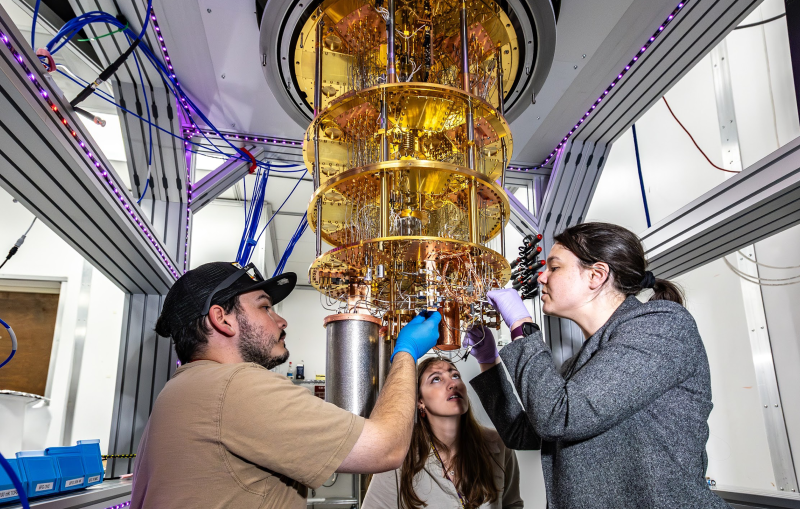
Efforts are underway at the Department of Energy’s SLAC National Accelerator Laboratory to study and manipulate the structures and properties of quantum materials at the atomic level. Using the bright and powerful X-rays at SLAC’s Stanford Synchrotron Radiation Lightsource (SSRL) and Linac Coherent Light Source (LCLS) – both DOE Office of Science user facilities – combined with advanced computational methods, researchers can peer into the ultrafast world of atoms and molecules to trigger and understand the behavior of quantum materials and develop new ways to synthesize these special materials.
SLAC staff scientistWe can make a deep impact in fundamental science as well as technological innovation.

“While the field of quantum materials is quite expansive and rapidly evolving, the level of sophisticated tools, most notably our world-class user facilities, makes SLAC a special place in this area,” says Joshua Turner, a lead scientist at SLAC. “We can make a deep impact in fundamental science as well as technological innovation.”
For questions or comments, contact the SLAC Office of Communications at communications@slac.stanford.edu.
About SLAC
SLAC National Accelerator Laboratory explores how the universe works at the biggest, smallest and fastest scales and invents powerful tools used by researchers around the globe. As world leaders in ultrafast science and bold explorers of the physics of the universe, we forge new ground in understanding our origins and building a healthier and more sustainable future. Our discovery and innovation help develop new materials and chemical processes and open unprecedented views of the cosmos and life’s most delicate machinery. Building on more than 60 years of visionary research, we help shape the future by advancing areas such as quantum technology, scientific computing and the development of next-generation accelerators.
SLAC is operated by Stanford University for the U.S. Department of Energy’s Office of Science. The Office of Science is the single largest supporter of basic research in the physical sciences in the United States and is working to address some of the most pressing challenges of our time.
Quantum explained

Related stories
Containing multitudes: SLAC scientist collaborates to create scalable qubits


Containing multitudes: SLAC scientist collaborates to create scalable qubits


